|
Sothos learn tricks of safe
driving
TONY HOWARD
THE
STAR'S 'Roof of Africa' Rally is not the only event of the year to make
life exciting on the roads across Lesotho.
In
fact the year-round motoring scene has become so exciting that officials
are seriously concerned! Last year they enlisted the help of volunteers
from the Institute of Advanced Motorists of South Africa, and recently an
IAM team again went to Maseru to help brush up local driving standards.
The man whose initiative got this scheme off
the ground is Mr
Neo Mohaese,
Lesotho's Traffic Commissioner, who learned his trade during five years
with the Johannesburg Traffic Department and later during an instructive
stay in Britain.
Mr
Mohaese currently has more than 5,000 registered drivers on his books, and
his department conducts 160 driving tests every month. Sixty per cent of
the candidates pass.
Of
this operation Mohaese says: "We try to follow the British pattern of
driving instruction and testing which involves a more benign approach than
in South Africa. By this I don't mean our standards are lower.
No tricks
“We aim to be constructive. Our examiners don't try to catch the learner
drivers out with tricks that unnerve them. They put them at their ease as
far as possible. And, if a candidate is failed, he is told why with advice
on how to overcome his particular driving deficiency.”
Nonetheless, the accident rate is high. While there are no sophisticated
statistics to support this, Lesotho's traffic boss says his eyes give him
all the evidence he needs every day.
There are between 10 and 15 accidents a week, and some pessimistic
arithmetic with available figures suggests that Lesotho's accident rate is
nearly twice as high as South Africa's.
On
those tortuous mountain roads and tracks, an accident can present
retrieval problems which may take days to solve. The odds are that the
vehicle just cannot be extricated from a steep rocky slope, or it is so
seriously damaged as to make recovery not worth the toil involved.
Heartening
A
small country with limited resources has far better things to do with its
money than to spend it on unproductive and avoidable activity. And so
‘advanced motoring’ is coming to the rescue. It was heartening to see the
enthusiastic response from the 270 Government drivers involved in the
recent four-day driving programme. They all took it very seriously, and a
number of members of the public turned up unprompted to take advantage of
the IAM instructors’ knowledge.
Two members of the instructing team were taking - literally - a busman's
holiday. One of them -
John Konigkramer - is an instructor with Putco whose buses serve African
townships, and the other is Robert van der Vyfer who trains tanker drivers
for Total Oil.
It
was no picnic for them on the test route up and down Lancers Gap - a road
familiar to ‘Roof of Africa’ enthusiasts. Predictably, there were many
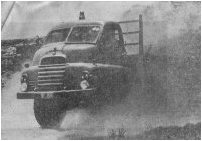
‘hairy’ moments as the big trucks slid sideways to halt in swirling clouds
of dust during skid avoidance and control instruction.
Konigkramer said: “You could say we have to go about this the wrong way
round. We have to teach a man to get into a skid so that we can show him
how to get out of it. Then once he’s realised how frightening a big slide
can be, we can show him how to avoid skidding at all. The trouble is
that a number of these fellows start to rather enjoy
themselves sliding
along on the dirt with the wheels locked.”
Another problem is caused, ironically, by the comparative lack of traffic
on Lesotho's roads. This lulls drivers get into a state of mind where they
are not expecting dangerous incidents when they do happen. This was
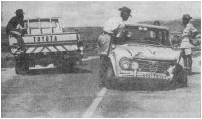
highlighted for us when a local driver gaily made a U-turn across the path
of a visiting TJ driver with expensive results.
The other members of the IAM team - Marilyn and Keith Poole and Dr Ken
Boffard - all had to adapt their testing technique considerably for Maseru
town traffic conditions. The lack of heavy traffic and complicated traffic
systems (robots, etc) made it impossible to give marks on about a third of
the points listed for observation on the IAM test sheet being used.
The traffic problem is only one of many in Lesotho. Characteristically
they are chipping away at it with increasing success. After only a day's
work, it was certainly apparent that the visiting drivers were getting
their message across.
As
Marilyn Poole said: “It's not that the local drivers are incapable of
driving well. They just need someone with a little expertise to give them
the self-confidence to do so.”
Traffic chief Mohaese arrived at a similar answer by a different route:
“The IAM is only telling our drivers the same things I have. But there is
something in the African mind which makes him always think that someone
from East or North or West knows better. As that’s the way it is, I am
only too pleased if the IAM can put across in four days the same message
that takes me a year.”
|
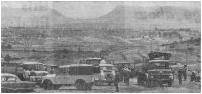
Lesotho’s scenery provided a magnificent backdrop for the wide
variety of vehicles on which advanced motorists instructed local
drivers. |
|
|
A casual U-turn by a Sotho ‘bakkie’ driver on the Leabua Highway
caused an expensive collision, ironically en route to a driver
training course. |
 |
|
A big four-wheel-drive Bedford recovery truck kicks up the dust
during an emergency stop below Lancers Gap. This vehicle can be
painfully slow on steep climbs and, if it gets out of hand coming
down a pass, the driver has his work cut out to control it. |
 |
Words &
pictures: Anthony Howard
944 words
Copyright ©
For The
Star, Johannesburg
|