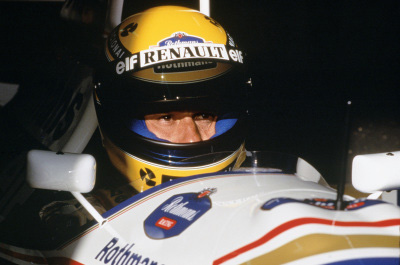
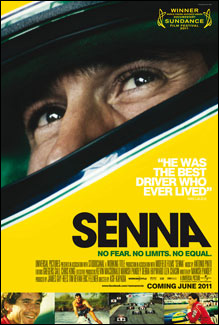
I blubbed with a mixture of fuck-me awe and racing-heart nostalgia during on-board camera sequences of Ayrton Senna lapping Monaco and other circuits. These brought me such vivid, wonderful recall of my own escapades, thumbing rides in Le Mans Jaguars and Porsches, and even being let loose in a Formula 1 McLaren. Many of us nowadays view TV coverage of Formula 1 grands prix as a PlayStation experience in which increasing familiarity diminishes impressiveness even on large HD screens. However, imagine blowing the spectacle to maybe 16 x 22 metres in an IMAX theatre with full-on multi-channel sound. This has two main effects. First is to amplify shortcomings of material shot 20 or so years ago. This scarcely matters a damn because the second effect is to so intensify the sheer physicality of “being in the cockpit” with Senna as he takes a car by the scruff the neck and wrings every last iota of performance from it, almost inch-perfect over kerbs and narrowly dodging barriers. Memories I sobbed quietly with nostalgia as all the memories came flooding back: mates no longer with us; personalities good, bad and ugly; the intense almost screw-loose competitiveness of team principals, designers and engineers; the joys of being so close to such fantastic cutting-edge engineering and drivers with the motivation, skill, courage and luck to maximise their opportunities. And inevitably I shivered with foreboding as the dénouement proceeded inexorably towards ghastly conclusion, analysis and widespread grief. This too also brought back memories – of watching with horrified but detached curiosity as Tom Pryce died during the 1977 South African Grand Prix. In this most bizarre of accidents, Pryce was struck in the face by a fire extinguisher carried by a marshal sprinting across the pits straight. Marshall and extinguisher were flung high in the air. With Pryce now dead at the wheel, his Shadow DN8 continued flat-out down the main straight, all the way veering into the left-hand track-side barriers, until it T-boned an unsuspecting Jacques Lafitte’s Ligier into the catch fences at Crowthorne corner. Never the less, I was in good company. I doubt there was a dry eye in the house at the end of the recent screening I attended. Reportedly, after writer and executive producer Manish Pandey screened the film for Ron Dennis, McLaren F1 team boss from 1981 to 2009, Dennis cried for 10 minutes. Then for a couple of hours he reminisced about Senna, who won 35 grands prix and three world titles with McLaren in 1988-1993. Pyrotechnics Senna is a brave undertaking. For one thing, motor racing movies have never quite seemed to hack it in cinemas. John Frankenheimer’s 1966 spectacular Grand Prix was shot on location at races throughout Europe. It had a star-studded cast – including James Garner, Eva Marie Saint, Yves Montand, Francoise Hardy and Graham Hill – and wonderful locations. It won Oscars for editing, sound and sound effects. It had great stunts with awesome pyrotechnics. And, during one scene shot at Brands Hatch, Frankenheimer even had a catering truck blown up to trigger a livelier reaction from torpid extras. However, corny dialogue, drippy love interest and Formula 3 machines thinly disguised as F1 cars left aficionados unimpressed. Lee H Katzin directed Le Mans, using footage from the 1970 vingt-quatre heures race, and released the movie in 1971. Steve McQueen, pretty handy behind the wheel and definitely a box office lure, led a cast – including Siegfried Rauch, Elga Andersen and Ronald Leigh-Hunt – difficult to recall 40 years later. Enthusiasts enjoyed right-in-the-thick-of-it sequences from one of – if not the – world’s greatest motor race/s. A sketchy plot with a contrivance or two but no dialogue for the first half hour failed to distract from the raw energy of Porsche 917s and Ferrari 512s battling towards a tense conclusion. Unintentionally, established sports car racer David Piper lent greater realism to the film, crashing his Porsche spectacularly and losing part of a leg in the process. Happily, this has not deterred him from racing actively to this day. Though not a smash hit by Hollywood standards, Le Mans retains a cult following. Spadework Senna is no different in that it has taken years of spadework and huge persuasion to bring to the screen. However, it has the advantage in this instance of truth being stranger – far more spellbinding – than fiction. You couldn’t have made it up and, if you had, no-one would have believed you. In early 2006, writer and executive producer Manish Pandey and fellow executive producer James Gay-Rees visited Sao Paulo to pitch to Senna’s mother and sister. Who better to outline this ripping yarn than Pandey? He says: “Senna is the true story of Brazilian Ayrton Senna, who many believe was the greatest racing driver who ever lived. “At the age of 24, he exploded onto the Formula 1 scene, in the deluge of a street race in Monte Carlo, then spent the next decade as the sport’s brightest star, shattering records, living life on the very edge and fighting the off-track politics which kept him from what he most loved: ‘pure racing’.
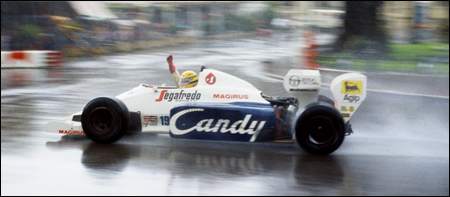
“In his quest to establish himself as the best, Senna engaged in an intense rivalry with world champion Alain Prost, which became the stuff of motor-racing myth and culminated in several high-speed on-track incidents which could have cost either man his life. “By the age of 31, Senna was a triple world champion, the world’s biggest sporting icon and had the status of a god in Brazil. “But Formula 1 can also be a cruel sport and, at the San Marino Grand Prix in 1994, hundreds of millions of people watched tragedy unfold at the blackest weekend in the sport’s history – culminating in the death of Ayrton Senna – and an outpouring of grief that is reserved for heads of state. Sixteen years on and Senna is a legend in Formula 1 and a saint in his native Brazil.” Rough-cut Double BAFTA-winning director Asif Kapadia and his team had a mighty task on their hands. For they had to distil 15,000 hours of archive footage – much of it inevitably under Bernie Ecclestone’s stewardship – from so many sources and events down to a coherent movie. Eventually, they arrived at a five-hour rough-cut, before slicing it down to three and then two-and-a-half hours. At which point the process became really challenging. While the international – leave ‘em wanting more – cut shown in the UK and elsewhere runs for an hour and three quarters, there is an extended version that turns for almost two and three-quarter hours. For some reason, the latter variant brings to mind Rudyard Kipling’s aphorism: "A woman is only a woman, but a good cigar is a smoke." By and large, Kapadia lets the footage run the narrative, with minimal reliance on talking heads. Instead he introduces pre-recorded voiceovers periodically, and this overall technique lends real immediacy to the piece. Unsurprisingly, he can’t please all of the people all of the time, as running time constraints inevitably impose considerable omissions, among them Senna’s phase in F3 when Martin Brundle gave him a good run for his money. Much of the film turns on the relationship between Senna and French rival Alain Prost, especially during their 1988-1990 “partnership” together at McLaren. What was to develop into a very conspicuous vendetta had its origins in the 1984 Monaco Grand Prix. Torrential After a 45-minute delay, the race started in rain so torrential that, as I stood drenched next to the Armco at Massenet atop the hill just before Casino Square, the leader was the only driver who could see any tarmac. All the other lunatics were engulfed terrifyingly in blinding clouds of spray. Prost (McLaren-TAG) led the race away from pole while René Arnoux (Ferrari), Derek Warwick (Renault) and Patrick Tambay (Renault) were eliminated immediately. As Prost faltered with a misfiring engine, Nigel Mansell (Lotus-Renault) snatched the lead and extended it by 2 seconds a lap until he smacked the Armco six laps later. This handed the lead back to Prost, who then came under increasing pressure from an upstart, Ayrton Senna who appeared from nowhere driving a Toleman-Hart, generally dismissed as uncompetitive.
On lap 29, Prost signalled to stewards to stop the race, and tried again on lap 31. Clerk of the course Jacky Ickx determined the weather was too severe to continue, and red-flagged the race on lap 32. Senna passed Prost as he slowed towards the finish line, but Prost was awarded the win based on positions on lap 31. There was quite a hoo-ha, giving Senna his first real taste of F1 politics. Observers noted the rain was if anything abating, and also that Prost’s McLaren had a Porsche-designed TAG engine. Ickx was a highly successful driver for Porsche in long-distance sports car racing. And, facing suggestions that this may have influenced his decision, he was suspended for not consulting stewards. This episode contrasts starkly with Senna’s narrative about his karting days early in the film: “In ‘78 I came to Europe to compete for the first time. It was pure driving. It was real racing. And that makes me happy.” Bête noir That first Monaco experience – of the real world, one might say – insinuated the notion of an “old Europe” Francophone stitch-up into the mind of Senna, a “new world” Portuguese-speaking colonial from across the south Atlantic. One main antagonist, of course, was Prost – known as “the professor”, who always made time to talk to the media, whereas you had to be quick on your feet to snatch a couple of minutes with Senna.
Inevitably, the other French bête noir was Jean-Marie Balestre Not covered in the film but worth a brief diversion is the challenge to Balestre for the FISA presidency in 1991 by British barrister Max Mosley, son of baronet and right-wing politician Sir Oswald. The eloquent Mosley junior’s track record included co-founding the March F1 team and acting as legal adviser to the Formula One Constructors Association. His declared motive was Balestre’s alleged intervention on the part of his compatriot Alain Prost to influence stewards in disqualifying Senna from the 1989 Japanese Grand Prix, thus deciding the world title in Prost’s favour. Mosley’s campaign argued that Balestre – also president of the Fédération Internationale de l’Automobile and of the Fédération Française du Sport Automobile – could not handle all three roles effectively. Fair play Some of world motor sport welcomed the prospect of English fair play in place of unabashed Gallic self-interest. Mosley’s tenure, which soon saw FISA merged into the FIA, endured until mid-2009. His position weakened by the News of the World’s revelation of a sado-masochistic spree, he stood down, opening the way for an election contest in which Ari Vatanen challenged Jean Todt, the present incumbent.
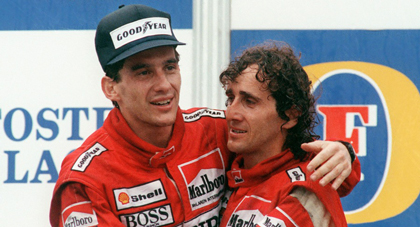
In January 1988, I accompanied Jean Todt across the Sahara, shadowing Paris-Dakar in the Peugeot team aircraft. Early one morning, Ari Vatanen’s 205 Turbo 16 was stolen from the bivouac at Bamako in Mali. I joined in a Keystone Cops chase to retrieve the car, but this came too late for rally favourite Vatanen to comply with his designated start time. However – after Todt intervened by lodging an appeal accompanied by the obligatory briefcase full of cash – the organisers allowed Vatanen to set off on a headlong dash to regain his lead. Hearing of this, the then FISA president Jean-Marie Balestre was enraged and issued a statement from his HQ at Place de la Concorde in Paris, banning Vatanen from the rally. The statement reached us – Todt and a small group of newsmen – via satellite as we stood in the shade of an aircraft wing on a desert airstrip in Mauretania. Napoleon "Jean Todt is little more than a small-time navigator, who now finds himself a member of the international jet set, with an apartment on the Avenue Foch," thundered Balestre. "He is the Napoleon of the dunes and the Bonaparte of the pyramids." Quick as a flash, Todt retorted: "That has to be better than being the Emperor Bokassa of the Place de la Concorde." And so this hilarious spat rapidly sent waves of laughter around the world. Returning to the film, it includes insights from John Bisignano (American pit lane reporter for ESPN), Reginaldo Leme (Brazilian journalist and TV commentator) and Pierre van Vliet (Belgian sports journalist and TV commentator, who hit it off with both Senna and Prost). Also reminiscing are Professor Sid Watkins (distinguished British neurosurgeon, leader of F1’s on-track medical team – 1978-2005, president of the FIA Institute for Motor Sport Safety, close friend of Senna), Frank Williams (British founder of the final F1 team for which Senna drove) and Richard Williams (British author of The Death of Ayrton Senna and chief sports writer of The Guardian). Neyde Senna (Ayrton’s mother) and Viviane Senna (Ayrton’s sister) make brave contributions too. Remain alert throughout, and you’ll be rewarded in all sorts of ways. At one point the loveable mouth of motor racing Murray Walker bursts out of the soundtrack – “Oh, my goodness, this is fantastic!” – only to be tempered by a more suave observation – “I think we are watching the arrival of Ayrton Senna, a truly staggering talent.” – from James Hunt. What good company they both were. Fangio And, in another quick cut, I think, my god, that’s Fangio embracing Senna up there on the podium. I catch my breath as I recall locking eyes with the quiet-spoken bright-eyed Argentino, five-times world champion, while I interviewed him in his mid-70s. Such courtesy, clarity, recall, enthusiasm, engagement: “And women rule our lives, don’t they?" Juan-Manuel Fangio would have been 100 years old this year. Four-times F1 champion driver Alain Prost won more titles than any other driver except Fangio and Michael Schumacher, and Prost’s record 51 victories were only overtaken by Schumacher in 2001. Noted for his smooth style, conserving tyres and brakes, Prost nevertheless was drawn into feuds with rivals, including Nelson Piquet, Nigel Mansell and most notably Ayrton Senna with whom he had a series of contentious skirmishes. After three seasons with Team Lotus, Senna joined Prost with his blessing at McLaren in 1988. In Portugal, Prost made the better start but Senna pushed past him onto the first corner. When Prost retaliated and went to pass Senna at the end of the lap, Senna moved to squeeze him into the wall at 180 mph/290 km/h. However, Prost stuck to his guns and went on to win. In a year when the 11 best scores were counted, the pair won 15 of 16 races. Though Prost scored more points overall, Senna was champion with eight wins to seven. Prost's attempt to put a brave face on it while in the embrace of his delighted team mate was not hugely successful.
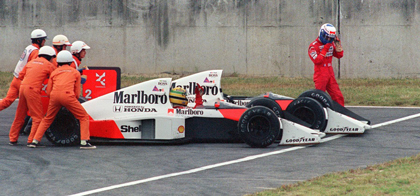
The antagonism between the pair intensified at the 1989 San Marino race. Prost and Senna had agreed that neither would hinder the other on the way into the first corner, and Senna led from the start without incident. When the race was re-started after Gerhard Berger’s lap 4 accident, Prost made the quicker getaway but Senna nevertheless pushed past him into the first corner. Poised Came the penultimate race at Suzuka, and Prost led the championship with 72 points to Senna's 60. Though Senna was on pole, Prost made the far better start and increased his lead to six seconds in the first half. Then a new set of tyres enabled Senna to begin closing on Prost, catching him by lap 40. On lap 46, through the 130R ultra-fast left-hander, Senna was poised to overtake and began to do so into the chicane. Prost moved across to block Senna, and neither would give way. So the two slid to a halt, engines stalled and wheels interlocked, in the chicane escape road. Prost – thinking game over – climbed out of his car while Senna cadged a bump-start from marshals, called at the pits for a new front wing, and pressed on to win the race.
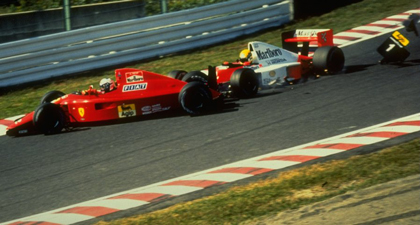
However, he was immediately disqualified for taking a shortcut through the chicane, handing the race win to Alessandro Nannini and the championship to Prost. At a FISA appeal hearing in Paris later in the week, Senna’s disqualification was upheld. For good measure, he was fined US$100,000 and faced a suspended six-month ban. Was Senna’s overtaking attempt altogether too bombastic? Did Prost collide with Senna deliberately? Or was it an everyday racing incident between increasingly antagonistic team mates? I’d say all three, but you decide. In any event, sensing that McLaren favoured Senna because of his close ties with Honda, by mid-season Prost had already signed with Ferrari for 1990. Though this wasn’t going to make the rivalry go away. Back in Japan for the penultimate race of 1990, Senna led the title chase with 78 points to Prost’s 69, while McLaren-Honda held 118 points to Ferrari’s 100. After winning pole position, Senna told the stewards it was on the dirty side of the track whereas it should always be on the clean racing line side where there is most grip. Accordingly, they agreed to swap first and second grid slots, but Jean-Marie Balestre briskly vetoed the decision. True to his word Thus Senna pledged that if Prost, second on the grid and on the grippier side of the track, got an advantage away from the line, he would never make it through the first corner. Senna was true to his word, shoving Prost at 170 mph/270 km/h across the gravel and into the tyre barriers. Senna and McLaren has clinched their titles, leaving Prost and Ferrari to settle for second places.
In the 1991 German Grand Prix, while Mansell (Williams-Renault) was running away with the lead, Prost (Ferrari) and Senna (McLaren-Honda) were disputing fourth place. On the way into the first chicane on lap 37, Prost was the quicker and attempted to overtake Senna around the outside. Senna would have none of it, so Prost went off, stalling his engine. Senna later faced the poetic justice of running out of fuel on the final lap for the second race in succession. Their rivalry was manifest both in their on-track battles and in a war of words. So we hear Prost declaring: “Ayrton has a small problem He thinks that he can’t kill himself. And I think that’s very dangerous.” Senna for his part asserts: “You are competing to win. And, if you no longer go for a gap, you are no longer a racing driver.”
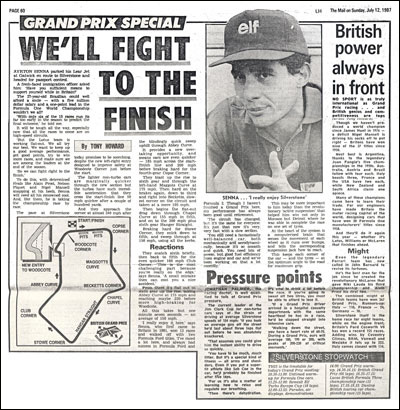
The millions of words that must have been written or spoken about Ayrton Senna da Silva inevitably include myriad adjectives, among them: articulate, controversial, courageous, focused, virtuoso, patriotic, philanthropic, quick, ruthless, shy, spiritual, tragic, religious. And as the soundtrack relates: “There was an energy, a force, a spirit that was electrifying.” If I may, I’ll conclude with this July 12 1987 page from my Mail on Sunday clippings file, which I hope captures something of the beginnings of Senna’s burgeoning success: 3246 words copyright © 2011 by Anthony Howard Picture credits from the top: Universal Pictures; Gabriele; Mike Powell/Getty; Anon; Getty Images; STF-AFP/Getty; Toshifumi Kitamura/AFP/Getty; Allsport; LAT. Read this Senna the Movie story in the Pattaya Mail, Thailand: http://www.pattayamail.com/automania/senna-4669
AYRTON SENNA parked his Lear Jet at Gatwick en route to Silverstone and headed for passport control. A fresh-faced immigration officer asked him: ‘Have you sufficient means to support yourself while in Britain?’ The 27-year-old Brazilian could well afford a smile - with a five million dollar salary and a one-point lead in the Formula One World Championship wouldn’t we all? ‘With only six of the 15 races run it’s far too early in the season to predict the final outcome,’ he told me. ‘It will be tough all the way, especially now that all the races to come are on high-speed circuits. ‘But the Lotus team is working flat-out. We all try our best. We want to keep up a good average performance, get good points, try to win more races, and make sure we are among the leaders at the end of the season. ‘So we can fight right to the finish.’ To do this, with determined rivals like Alain Prost, Nelson Piquet and Nigel Mansell snapping at his heels, Senna will need all his renowned cool. And, like them, he is taking the championship race by race. The pace at Silverstone today promises to be scorching, despite the new left-right entry designed to improve safety at Woodcote Corner just before the start. The lighter non-turbo cars are marginally quicker through the new section but the turbos have such incredible acceleration that they cross the start-finish line 50 mph quicker after a couple of hundred yards. And they approach the comer at almost 240 mph after the blindingly quick sweep uphill through Abbey Curve. It provides a new overtaking opportunity, and means cars are even quicker - 185 mph across the start-finish line and 200 mph before braking hard for the fourth-gear Copse Corner. They blast up the rise to sixth gear and through the left-hand Maggots Curve at 175 mph. Then hard on the brakes again, down to third and right into Becketts, slowest corner on the circuit and taken at a mere 105 mph. Then begins the flat-out drag down through Chapel Curve at 155 mph in fifth, and on to the 200 mph plus sixth gear Hanger Straight. Braking hard for Stowe Corner, they snick down to fifth, and sweep through at 150 mph, using all the kerbs. Reactions They snatch sixth briefly, then back to fifth for the even quicker 160 mph Club Corner. ‘This is the most challenging part because you’re really on the edge,’ says Senna. ‘A small mistake then can cost you a nice accident.’ From there it’s flat out in sixth gear up the rise, taking Abbey Curve at 175 mph and reaching maybe 220 before more high-braking for Woodcote. All this takes but one minute seven seconds - an average of 158 mph. ‘I really enjoy it here.’ says Senna, who first came to Britain in 1981, won 12 races and walked off with two Formula Ford titles. ‘I’ve raced a lot here, and always had success in Formula Ford and Formula 3. Though I haven’t finished a Grand Prix here, my performance has always been good until retirement. `The circuit has changed, but it’s the same for everyone. It’s just that now it’s very, very fast with a slow section. ‘You still need a fantastically well-balanced car, both mechanically and aerodynamically, because it’s so smooth and quick. You need lots of power, but good fuel efficiency from engine and car and we’ve been working on that a lot recently.’ This may be more important to him today than the revolutionary ‘active suspension’ that helped him win not only in Monaco but Detroit where he was able to complete the race on one set of tyres. At the heart of the system is a computerised brain that senses the movement of each wheel as it runs over bumps, and tells the corresponding suspension jack how to react. This keeps each corner of the car - and the tyres - at the optimum angle to the road for maximum grip. British power always in front NO SPORT is as truly international as Grand Prix racing . . ..and British genius and competitiveness are tops (writes Tony Howard). Though we haven’t produced a world champion since James Hunt in 1976 - a deficit Nigel Mansell is driving his socks off to put right - Britons have won nine of the 37 titles since 1950. Next best is Argentina, thanks to the legendary Juan-Manuel Fangio’s five championships in the 1950s. Australia, Austria and Brazil follow with four each. Italy boasts three, France and the USA have two each, while New Zealand and South Africa claim one apiece. Many of these champions came. here to learn their trade. For our engineers have made Britain the motor racing capital of the world, designing cars that have won 20 Formula One manufacturers’ titles since 1958. And they’ll do it again this year - whether it’s Lotus, Williams or McLaren that finishes ahead. Might Even the legendary Ferrari team has now called in John Barnard to revive its fortunes. He’s the best man for the job since he created the revolutionary McLaren that gave Niki Lauda his third championship and Alain Prost his first two. The combined might of British teams have won 267 Grand Prix. Runners-up: Italy - 110, France - 24, Germany - 10. Silverstone itself is the home race for eight teams, while on the engine front, Britain’s Ford Cosworth V8 has won a record 155 races. Adding wins by Coventry Climax, BRM, Vanwall and Weslake it tots up to 223. Italy comes closest with 114. Pressure point JONATHAN PALMER, the racing doctor, is well qualified to talk of Grand Prix pressure. The current leader of the Jim Clark Cup for non-turbo cars says of the strain of driving at average Silverstone speeds of 154 mph: ‘if you took an average guy off the street he’d last about three laps flat-out before he was absolutely knackered. ‘That assumes you could give him the instant ability to drive so quickly. ‘You have to be much, much fitter. But it’s a special kind of fitness - all arms and shoulders. Even if you put a super-fit athlete like Seb Coe in the car, he’d probably be finished after five laps. ‘For us it’s also a matter of learning how to relax and regulate our breathing. ‘Then there’s dehydration. It’s vital to drink a lot before the race. If you’re going to sweat off two litres, you must be able to afford to lose it. ‘if a Grand Prix driver arrived in a hospital casualty departments with the same heartbeat he has in a race, he’d be slapped straight into intensive care. ‘Walking down the street, you have a heart rate of 60-70. During a Grand Prix, ours will average 180, 190 or 200, with peaks of 200-230 at critical moments.’ SIlVERSTONE STOPWATCH THIS is the timetable for today’s Grand Prix meeting: 10.30-11.00: Untimed warm-up for Formula One cars. 11.25-12.00: Renault Elf Turbo Europa Cup (18 laps). 12.00-13.55. Parades, air displays, demonstrations. 14.00: Grand Prix warm- up. 14.30-16.15: British Grand Prix (66 laps). 16.35-17.15: Lucas British Formula Three championship race (15 laps). 17.35-18.15: Dunlop British touring car championship race (15 laps). 1206 words Copyright © for Mail on Sunday |
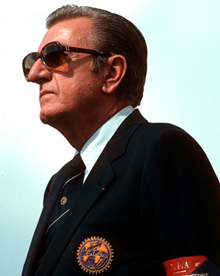 (pictured right). Apparently once photographed while kitted out as an SS colonel on Nice railway station in 1944, he
was generally recognised as batting for France. President of the Fédération Internationale du Sport Automobile from 1978 to
1991, an overbearing Balestre is seen in the film, playing hard ball at a drivers’ briefing – and being confronted by a very articulate Senna.
(pictured right). Apparently once photographed while kitted out as an SS colonel on Nice railway station in 1944, he
was generally recognised as batting for France. President of the Fédération Internationale du Sport Automobile from 1978 to
1991, an overbearing Balestre is seen in the film, playing hard ball at a drivers’ briefing – and being confronted by a very articulate Senna.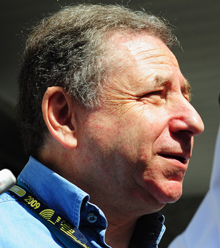 One time driver and co-driver Todt (left) led Peugeot Sport to success in world championship rallying, the Paris-Dakar Rally and long-distance sports car racing. More recently, Todt masterminded Ferrari’s F1 glory years with Michael Schumacher. Mosley has since devoted his energies to campaigning
via the courts and the media for changes to privacy law.
One time driver and co-driver Todt (left) led Peugeot Sport to success in world championship rallying, the Paris-Dakar Rally and long-distance sports car racing. More recently, Todt masterminded Ferrari’s F1 glory years with Michael Schumacher. Mosley has since devoted his energies to campaigning
via the courts and the media for changes to privacy law.