|
Recommended ‘I HAVE reviewed this book twice now because I think it is the best book that I have read on this subject. It has a nice style and is very readable. I have recommended it to everyone.’ |
|
|
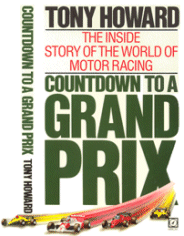
The best ‘CONGRATULATIONS – the best book on the subject I’ve read.’ Fearsome sport ‘This must be the most comprehensive guide to motor racing one could find. It is intended for the TV viewer as much as for the circuit fan and details all the myriad facets of this fearsome sport. The drivers and their characters, the appalling dangers, the crashes, the safety measures, the inner workings of cars and administration, comprise a fascinating and valuable book.’ Space-age survival at the Grand Prix THEY TRAVEL faster than the take-off speed of a Jumbo jet, and display the inch–perfect precision associated with a space shot. That much you’ll see tomorrow when 26 of the world’s most potent, powerful cars roar away from the grid at Brands Hatch in the British Grand Prix, run in association with the Daily Mail. What you won’t see is the incredible life-support system that has evolved to try to ensure the drivers survive the 96 minutes or so that the race takes. They are today’s gladiators, battling at frightening speed – tomorrow’s winner will average around 124 mph. for the race. Never before has man and car been at such outer limits of performance; and never before has such spectacular technology been harnessed to such an extent to back them up. Here, item by item, the Mail’s motoring experts take you through it: THE EQUIPMENT: The major fear of every driver is fire, of being engulfed in up to 48½ gallons of blazing petrol. So every inch of flesh has to be protected. Nigel Mansell, who’ll be in a John Player Special Lotus tomorrow, demonstrated for the Mail. He begins with Just a pair of shorts and thin socks, then pulls on a cream-coloured polo neck sweater and long johns. They’re knitted from fire-retardant fibre. Then the suit, five layers thick and also made of fire-retardant fibres. Next the boots, leather and strapped and over the ankles. Then he puts in the essential ear plugs and reaches for the balaclava. The total cost: up to £1,500 a race. On top of it all goes the helmet, an extraordinary life-support system in itself, capable of withstanding the force of a sledge-hammer blow with a visor that can resist the blast of a 12-bore shotgun. It is fed directly with oxygen, triggered automatically in an emergency, to give the driver breathing time while creating pressure to keep flames away from his face. Cost: around £2,000. THE CAR: It is here that the most massive advances in technology take place. A Formula One car can cost £250,000 and is hand-made with all the finesse of a Swiss watch. The driver sits cocooned in a £30,000 survival cell, made of lightweight, stronger-than-steel Kevlar and carbon fibre. The electronics are a model of space-age science. THE EXTRAS: Off the track tomorrow, in case anything goes wrong, will be ten doctors, a £125,000 medical centre on constant alert, 12 ambulances, 120 St John’s staff, and emergency helicopters. Hailed as one of the finest TO CELEBRATE two years of the Mirror’s Motoring page we are giving away 50 copies of a new book, Countdown to a Grand Prix. Written by former Mirrorman Tony Howard and published by Arrow, it has been hailed as one of the finest books on Grand Prix racing. Really superb CONGRATULATIONS on a really superb book and I am confident Arrow will do a great job with it.…I’m sure it will make the paper back charts and Arrow will be looking for a good serialisation for it. One or two of the chapters there could easily be adapted for newspaper traffic....I would be delighted to look at any future book you have in mind. A professional of the old school VETERAN OF three Paris-Dakar Rallies, Autocar and the City Golf Club, Fast Lane contributor Tony Howard is a master of the hyperbolic florid phrase. He’s also – though not that old – a professional of the old school, and that really comes through in this book. Faced with the unenviable task of explaining the Machiavellian machinations (it’s catching) of the Grand Prix world in a 250-page paperback, he doesn’t just wax macho; he gets in there and does the job, and really rather well. The book seems to be aimed at a relatively young audience without too much prior knowledge of the subject, but Howard has managed to provide a wealth of information and anecdote that will be of interest to all Grand Prix fans. Every chapter adds a useful piece of background, either about why practice accidents happen, or the relationship between a driver and an engineer, or the differences between drivers’ techniques, or about sponsors or carbon fibre or circuit management. All in all it’s a jolly good yarn, one of the best features of which is interviews of many of the most important and influential people in the sport. Personally, I wanted to read more about why Grand Prix racing has fallen into the control of people like Bernie Ecclestone and Jean-Marie Balestre. But Tony Howard probably wanted to remain attached to his knee caps. If you are puzzled by some of the things Murray Walker says, you will probably remain so, even though he gets the chance to justify himself in this book. Two recent examples of his art were "Nelson Piquet is driving a pluperfect race" and "Mansell is leaving Prost under no illusion that he’s behind him". However, when you’ve read Countdown to a Grand Prix, even if you thought you knew a lot about motor racing beforehand, you will probably have learned a bit more. The thoughts of Formula One’s angry hero TOMORROW afternoon at Brands Hatch, Niki Lauda, winner of two motor-racing world championships and scarred survivor of a blazing Nürburgring accident in 1976, dons fireproof overalls, driving gauntlets, and fully enclosed helmet for his 151st Grand Prix. For the 35-year-old Austrian the fact that he could become the sport’s highest points scorer of all time by the end of the race means little. As one of the globe-trotting world-series elite, Lauda earns a basic annual retainer of £750,000 from the Marlboro-McLaren team but hardly projects the image of a superstar Grand Prix gladiator. Anyone keen to understand the Lauda anti-hero psyche and share a compelling inside view of the formula one circus should read Lauda’s new book. It is an altogether more mellow Lauda who clinically analyses the sport, from a mainly technical standpoint taking the family motorist and arch enthusiast alike into the cramped confines of a fearsomely powerful 650hp racing car. Lauda is not patronising towards his readership, but there are long passages in the book which require concentration or more than just a passing interest in this complex, dangerous and enormously expensive mixture of sport, show business and public-relations hype. Dubbed "super-rat" by motorsport writers, Lauda has always been his own person: blunt, direct, disarmingly honest and absolutely single-minded. Questioned about his lividly scarred face, the winner of 21 Grands Prix replied that estimates for cosmetic surgery after the accident were "very, very expensive", with no guarantee of success. Anyhow, Lauda pragmatically pointed out, the loss of most of his right ear makes long-distance telephone callers easier to hear. "I don’t give a damn about the good old days. To me, it doesn’t matter in the slightest whether they were good, bad or indifferent. What counts is today – and tomorrow," he says when asked about past glories. Lauda talks briefly about his return to racing after turning his back on the sport during practice for the 1979 Canadian Grand Prix, describing candidly how learning to get to grips again with an F1 machine was humiliating as he built up reserves of physical and mental stamina at the beginning of 1982. His guru and health adviser Willy Dungl contributes a short chapter on how he "tunes" Lauda for race-fitness. It was Dungl who helped put his bandaged protégé back in a racing car six weeks after Lauda received the last rites in a German hospital. One of the most fascinating sections of the book is Lauda’s explanation of how he rids himself of "funny" feelings on the morning of a race, waking with an unpleasant dry taste in his mouth. He rationalises his way back into a correct frame of mind in a sport, where, Lauda explains, there is no room for uncontrolled fear. Costing less than one-fifth of Lauda’s book is Tony Howard’s Countdown to a Grand Prix, a 254-page paperback which delves below the polished blue-chip veneer of Grand Prix racing. Apart from explaining the inner workings of Formula One it lays bare much of the deceit conceit and neurotic competitiveness which keeps the high-speed operators moving. Howard has pitched the text at the layman, and though the cliché book has had a fair thumbing, the outcome is highly informative, revealing, and useful volume for armchair television Grand Prix watchers, who number 1,100 million worldwide. Pocket-book size opuscule TONY HOWARD has tried to popularize F1 racing in his pocket-book size opuscule which includes two black and white photo albums. He does manage to fulfil his aim, although it is done a little less than perfectly. Although the first part of the book is interesting, the last chapters are frankly boring. Was it really necessary to give a minute account of Longines’ FI timing system? Or how our colleague Paul Treuthardt from the AP Agency transmits his texts? Howard confines his book to British drivers, teams and subjects in F 1, which gives it a rather insular flavour. Please note, however, that all buyers will be offered a reduction of £3.50 for any race in the British Isles. Too selective. Four formulas for success THE PLANNING required to stage a Grand Prix is as specialised and complicated as the skills necessary to bring a Formula One car to the starting grid; certainly complex enough to provide material for a substantial book on the subject. Countdown to a Grand Prix by Tony Howard (Arrow Books, £2.25) reveals, in meticulous detail, the inside story of grand prix racing. Howard’s astute observations are supported by discussions with representatives from every branch of the sport, and his research has not only been intense, but also impartial. For example, to complement the tobacco companies’ motives for spending £12 million on motor sport sponsorship, Howard puts forward the views of ASH (Action on Smoking and Health). Apart from providing many facts unknown to those working in the business this paperback is perfect for the armchair enthusiast. There are explanations about the way the cars are designed, how they are driven, who pays for them – and why Murray Walker occasionally confuses them. Thoroughly recommended THERE HAVE been many books written about motor racing, but few manage to convey the excitement, the frustration and the dedication inspired by the top echelon of the sport in the way that Howard achieves with Countdown. Tony Howard is a London-based South African. A member of the Guild of Motoring Writers, he has worked for Autocar magazine and the Daily Mirror newspaper but is now freelance. In 1982 he won the Conoco Jet Motoring Writers Award and Countdown was nominated for a Guild of Motoring Writers award in 1984. One of the adventurous school of journalists, Howard has ridden in the World Land Speed Record winning Thrust 2, and he has been a regular competitor in the gruelling Paris-Dakar rally. It is hardly surprising then that he was able to achieve a rapport with the drivers, designers and team managers interviewed in the preparation of his book. Therein lies one of the greatest attractions of the book, for although by now somewhat out of date, it still gives an astonishingly close and well informed insight into the world of Formula One and the World Championship. The strength and accuracy of this insight is borne out by the manner in which several predictions have subsequently come true. For example, Ken Tyrrell on the subject of Renault: "If they don’t win in 1984 they never will. No way are they going to be competitive in 1985 when fuel tanks are reduced to a hundred and ninety five litres. They’ll pull out then, and concentrate on the Indianapolis 500 or something. Somebody on the Renault board will say enough is enough." Of course, since the book was written, Renault have pulled out, but Tyrrell is still there using – ironically – Renault engines. Another quote, proven in the course of time to be remarkably prescient is this one from Frank Williams: "I admire Nelson – he has a quick head and I would go flat out to hire him if we were to lose Keke." In Countdown, Howard introduces the reader to the drivers, the environment, the designers and the team owners. He explains about race tactics and rule bending. He explains the evolution of the rules and the politics lurking inevitably in the background. Also explained is the tremendous impact which has been made on the sport since the advent of commercial, as opposed to trade, sponsorship. Inevitably, the question of accidents is raised – it must be in a sport where the likelihood of an accident, we are told, is one in ten per car. However, in Countdown, we see an effort to explain the reasons behind the accidents and the measures being taken to avoid recurrences. The politics of the sport are examined as we see the background to the showdown between the controlling body, Balestre’s FISA and the Formula One Constructors’ Association (FOCA), headed by the redoubtable Bernie Ecclestone, which led to the withdrawal of support from Goodyear until the two bodies had sorted out their squabble a few years ago. Tyres, too, come under the spotlight as the black art of compounding, and the tactics of the tyre companies and their users are examined. So, too are the complex, but highly accurate, system of timekeeping and the role of the media in keeping F1 at the pinnacle of all the world’s sporting spectacles, rivalled only by the Olympic Games and the soccer World Cup. Howard manages in Countdown to provide sufficient technical information for the newcomer to develop a reasonable working knowledge of F1 and there is some heady material too. Such as a description from the driver’s seat of the start of a race, which reads, in part: "Your head is snapped back with one and a half times the force of gravity. The car fishtails as the back wheels spin while you floor the throttle pedal. You fight to keep in a straight line with corrections on the steering, and the world becomes a wild blur." Or, as John Barnard is quoted once again, "Seven hundred plus horsepower in five hundred and forty kilos is pretty exciting, isn’t it? And two hundred mph plus is beeloody quick." Other interesting quotes come from Harvey Postlethwaite: "As Formula One has sprinted ahead technically and as a spectacle for vast worldwide television audiences,... the international governing body has remained in the era of the blue blazer and the leather armband." and John Barnard again: "The difficult part is that you can sit there, hands behind your head for two days, staring at the drawing board. That’s one of the reasons I’m glad I work in a closed office. Otherwise people walk by, and they think: ‘He hasn’t done a thing, produced anything.’ They don’t say it, but I know what they’re thinking." Event though Countdown is now a little out of date, it is nonetheless thoroughly recommended. Books for the enthusiast HOWARD has taken a long, critical look at the mysterious affairs of top motor racing and the result is a fact-packed and interesting study. It is aimed as much at the armchair fan of the weekend Formula One meetings as the racegoing expert. But among the informed pages are interviews and analyses appropriate for both groups. A driver is likely to crash once in every 10 races, and one in three of those shunts will be severe enough to incapacitate him. During a race, says Howard, a driver’s mind works at up to 10 times faster than an ordinary motorist’s. His body is subjected to twice the force of gravity. The book’s value is outstanding… Win and lose GRAND PRIX motor racing has largely sorted out its internal troubles and with regular television coverage is today more popular than ever. But what goes on behind the scenes before each race? How do the drivers cope with losing 10 lb of body weight in a hot race? What are the risks of crashing? The answers to these and a thousand questions to the sport are well answered in Countdown to a Grand Prix by rally driver and author Tony Howard… Serious interviews with serious people MANY READERS may already have seen Tony Howard’s look at the background of Formula One on station bookstalls and in high street shops such as WH Smith, for it is being heavily promoted. The fact that it is being promoted along with the latest from Barbara Cartland, and the fact that the cover is garish and the blurb over-excited, may have put off the serious enthusiast from buying it. Gentlemen, think again. Tony Howard has gone to great pains to thoroughly research his subject, as the extracts of serious interviews conducted with serious people in the sport illustrates. The result is a very readable introduction to the background of Formula One which the new enthusiast will find indispensable and which will also add to the knowledge of those who have closely followed the sport for years. This is not only an excellent book, but an important one. Its importance lies in the fact that it is inexpensive, easily available, accurate and responsible. It will, I am sure, convert many people who may casually watch racing on television into becoming serious enthusiasts. The wealth of information they will receive from Countdown To A Grand Prix will stand them in good stead for a long time. There are 24 pages of well chosen photographs, maps of the major circuits, a glossary of terms and brief profiles of all current Grand Prix drivers… Best, most comprehensive explanation "IT’S THE BEST BOOK I’ve ever read on motor racing — every fact is accurate" grinned Ken Tyrrell with the look of a man to whom motor racing books are generally an anathema. And the paperback so fulsomely praised? Tony Howard’s superb Countdown to a Grand Prix (Arrow Books E2.25 ISBN 0-09-935210-9). Howard is not an established Formula 1 journalist: and that is what makes Countdown such a good book. It takes as its premise that the average television race watcher wants to know exactly what makes Formula 1 tick. Aside from a schlock-ridden Prologue – "those concentrated two hours when (the driver) will once more flirt with destiny" – the 260 pager goes in to everything from testing to tyres, sponsorship to sidepods, engine design to entrepreneurs. Drawing heavily from a huge batch of interviews, Howard provides the best, most comprehensive explanation of how contemporary Grand Prix racing functions yet written. Stacks up as vital reading TONY HOWARD is a brave man. How else can you describe a journalist who shunts an F1 car and has the courage to admit it in print? Or, bolder still, makes the effort to get right behind the scenes of modern GP racing by writing a book such as Countdown to a Grand Prix? Published in paperback with numerous monochrome photographs, Countdown takes the reader through the entire GP spectrum, beginning with that frequently overlooked figure – the designer – and the problems of continuous development he must overcome, and then running through every other strand that comprises a modern GP team. Later a chapter is devoted to power units, but rather than simply describe the latest turbo wonders, Howard continues his style of tracing the circumstances that lead to their evolution, providing less informed readers with valuable background and the more knowledgeable with a useful refresher course. Other sections cover the importance of testing and tyre development, and there is even a detailed analysis of how race cars are timed. And, as if that isn’t enough, there’s also a look at the manner in which Grands Prix are reported by the media, introduced in amusing yet paralysingly apposite style: "The shark, dubbed the most efficient eating machine in the animal kingdom, goes on its predatory way with pilot fish always in attendance. The grand prix circus, the most voracious consumer of money in the sporting world, has the media instead". Nice analogy. The major criticism I have of this book is that to read it you’d think the only grand prix track in Britain is Brands Hatch. Overall. this one stacks up as vital reading for Grand Prix enthusiasts, especially as it sells for the price of two packets of fags. Read it before you next sit down to watch BBC 2’s Grand Prix programme and you’ll have a whole new insight into the sport. Book of the month PLENTY OF CHOICE for readers, although there has been a heavy emphasis on travel and motoring in the books dropping on this reviewer’s desk. Book of the month – for want of a better term – is Tony Howard’s Countdown to a Grand Prix (Arrow, £2.25) which takes the reader right inside the Grand Prix motor racing scene. It’s a lively book as befits a past winner of the Motoring Writer of the Year award and a man who has three times taken part in the tough Paris to Dakar Rally (you know, the one where Mark Thatcher got lost) Formula One family fortunes WHICH is the richest sport in the world? Boxing is a strong contender for the title. It can pay champions like Marvin Hagler more than £5m for just one fight. Tennis is another area for striking it rich. John McEnroe, with only three losses in 85 matches, won more than two million dollars on the professional circuit last year. Football? Italy is the place to go with Juventus reputed to be paying Frenchman Michel Platim at least £1m (which is three times what Kevin Keegan was paid when he was at Newcastle United and, then, Britain’s highest-earning soccer player). But ALL these sports – plus American football and baseball – have to bow to Grand Prix motor racing which is played for enormous stakes (life and limb being just two!) and astonishing financial rewards. To join the "family" of Formula One is to set yourself up against fabulous fortunes! Tony Howard, author of the excellent book, Countdown to a Grand Prix, estimates that backers of motor racing have created a cash bonanza totalling almost £200m! Tony, who has spent years writing for specialist motor magazines and watching GP races across the world points to the fact that even the down-market drivers with little or no hope of scoring championship points can earn a cool £½ million in a season. Somebody like three times world champion Niki Lauda can pull in more than £2m while his team-mate, Alain Prost, will make at least £1½m for his driving efforts this year. A driver like Nelson Piquet would earn well over £1m while our own Derek Warwick and Nigel Mansell would expect between £¾m and £1m from their respective teams. So how can the sport afford it? "Simple," says Tony. "Because of the enormous exposure it gets. Television audiences alone total just something like 900 million viewers. Just think of the advertising potential there!" But everything costs money. For £50,000 a firm will not get much. It will "buy" an association with a GP team. A couple of personal appearances by top drivers, entitlement to bring a few guests for a few races each year and the chance to blow your own trumpet on the publicity front. But positively no identification on the cars – that costs at least £250,000 a season! And sewing a badge on a driver’s overalls will set you back at least £65,000. How much do the teams spend? Howard reckons that the big boys like Ferrari (owned by Fiat), Renault (owned by the French government) and Alfa Romeo (owned by the Italian government) are spending between 20 and 30 million dollars a year to mount their own roadshow. And they employ hundreds in the process. To develop an engine, of course, costs millions of pounds. Renault, perhaps the most successful engine-builders at the moment (except that the ones fitted to their own cars are not winning while those fitted to rival machines are!) would charge about £1½m a year to a team seeking a complete power package. This is regardless of the number of engines sought – they remain the property of Renault! Howard says he feels the GP cash injection will get bigger as the cars get faster and the crowds become bigger. "People want heroes. Lauda is one. He came back from the dead and that makes him marketable. Motor racing brings real thrills – that is why it pays so well. Drivers stand to earn fortunes – be killed or badly maimed. That is the price of the sport." Grand prang MY CONGRATULATIONS to S Thorpe of High Wycombe, Bucks, and MW Hunter of Rustington, West Sussex, winners of our ‘Grand Prix’ competition. They will be entertained for a day out at Brands Hatch by Arrow, publishers of Countdown to a Grand Prix. The book’s author, racing journalist and rally driver Tony Howard will be taking them behind the scenes. Even better news is that a trip round the track with Howard is not on the schedule. The previous bit of promotional activity organised by Arrow and Howard included him zipping round the circuit in a Formula One car kindly loaned by Marlboro McLaren. Howard ploughed into a side wall at 120 mph, but escaped with bruises, all of which is to be seen on Breakfast Time just before the British Grand Prix in July. A chequered way of life GRAND PRIX RACING attracts millions of followers from all over the world. The stakes are high, but there is never any lack of competition to join the motor racing elite. In Countdown to a Grand Prix (Arrow. £2.25), Tony Howard takes you behind the scenes and investigates the industry as a whole. He talks to car designers, team managers, sponsors and drivers. shedding light on the intricacies of test runs and the web of power politics. Focussing on individual teams and drivers, the author assesses the risks and rewards, noting some chilling facts. For example, of the 200-plus drivers who have competed in Grands Prix between 1950 and 1983, more than 60 have met with violent deaths. A driver is likely to crash once every ten races, and one in three of those accidents will be severe enough to incapacitate him. This book is intended as much for TV viewers as racing experts and combines facts and figures with an exiting and atmospheric look at this dangerous, but glamorous sport. Imps’ formula for accelerating sales MORE THAN 80 million people in 50 countries around the world will watch today’s British Grand Prix on television. A further 70,000 will pack Brands Hatch, owned by John Danny’s Grovewood Securities. But no one will follow the race more closely than Imperial Tobacco, one of the sport’s biggest supporters. It is not only sponsoring the event, now called the John Player British Grand Prix, but also the John Player Special Lotus Team, known as the JPS Team Lotus. This year’s Grand Prix is the first in Britain to cost more than £1 million to stage, and Imps’ sponsorship of this event is estimated at £250,000. Peter Dyke, Imps’ head of sponsored events, puts the Grand Prix investment in perspective when he reveals that at the beginning of 1983, £200,000 was spent on literature alone sent out to Lotus supporters all over the world. Imps claims to be the market leader in Britain in motorsport sponsorship and Tony Howard, in his recently published paperback Countdown to a Grand Prix, says "Motor racing as a whole is thought to soak up half of the $40 million sponsorship money spent by British industry and commerce and Formula One must take a lion-sized share." The Tobacco Advisory Council estimates that the industry spent £5 million on sports sponsorship in Britain in 1982 (£5.5 million today). The Sports Sponsorship Advisory Service gives £19.5 million as the total spent by all commerce and industry on motor-racing sponsorship for 1982. This amounts to 42 per cent of the money spent in Britain on sponsoring all sports, from soccer to snooker. And nothing burns up money like a turbo engine. Driving at an average 130 mph over 196 miles, the two John Player Special 95T cars will each consume a gallon of five-star petrol every two minutes. Over a season it is thought that the Lotus team, including two drivers, mechanics, engineers and designers, could cost as much as $7 million to run. But Dyke sees this investment in terms of helping to retain market share and the brief cooling of Imps’ love affair with motor-racing made the company realise how much it needed fast cars to make fast sales. Imps chairman, Geoffrey Kent, was the first man outside the motor industry to see the potential of this sort of sponsorship. In 1967 the late Colin Chapman, head of Group Lotus, approached 100 British companies for support. Only Kent said yes. The partnership lasted through to 1979 when Imps stopped and re-evaluated its presence in the sponsorship of motor sports. Two years later, Dyke says: "We realised that a very strong part of the profile of John Player was in Formula One and that it was a valuable part of our portfolio." For the 12 months to October 1981 – the year Imps dropped out – its tobacco profits slipped by. £11.7 million to £68.7 million. Was it just coincidence that, back on the track, Imps’ profits accelerated up to £84 million for the year to October 1982? Since 1965 cigarettes have been banned from TV advertising so much of the visibility comes from sponsorship. This year, Lotus cars will race 16 grands prix, watched world-wide by over a billion people. Up-market, elegant and distinctive, the black and gold team colours immediately recall the cigarette packets. Both activities – Grand Prix racing and smoking – are dangerous and cost a packet. But Imps clearly feels it is cash well spent – particularly if Lotus wins this afternoon. For the buffs For those who want to know what makes the whole multi-million-pound business of Formula 1 tick, there is no better guide than Tony Howard’s Countdown to a Grand Prix (Arrow paperback £2.25, or £9.95 hardback, Severn House, Hutchinson). The book has appeal for both the knowledgeable fan, who will find out things he did not realise before, and for the newcomer, who is completely bemused by all the noise and spectacle. A copy of this book should be part of every grand prix fan’s equipment, together with his programme, stopwatch and lap chart. Technicolour response THE BRITISH GRAND PRIX takes place in mid-July; and just before then BBC Breakfast TV will run an action film of an Arrow publicity stunt for its recently published paperback original, Countdown to a Grand Prix (£2.25), motoring journalist Tony Howard’s behind-the-scenes look at Grand Prix racing. It is a startling piece of film, unintentionally. The BBC crew arranged to be at Brands Hatch to film Tony Howard driving a Formula One car around the circuit. The day dawned damp and drizzly, the track was slippery, and Tony Howard crashed the £250,000 McLaren car into a crash barrier at 120 mph and took off the two front wheels. It was all recorded in brilliant technicolour by the cameras, as was, by microphone, Mr Howard’s equally technicolour response. Fortunately, Tony Howard escaped with only a stiff neck and injured pride. Breakfast TV was delighted with its action film. McLaren was less than delighted at the damage to its car, but accepted it with good grace. Arrow, once it realised it was not expected to pay for the car, adopted a cheery ‘all publicity is good publicity’ attitude and vowed to stick to sending out review copies in future! Grand Prix give-away FEW SPORTS are more exciting than motor racing – only the Olympics and World Cup football are more popular In the TV ratings than a Grand Prix. Now journalist Tony Howard has analysed the attraction – and the dangers – of the sport in a dramatic 250-page book, Countdown to a Grand Prix (Arrow, £2.25). And 50 free copies of the book are available to Titbits readers, giving you the chance to take up Arrow’s offer of a free entry voucher to any one of 12 race meetings being held this year at Brands Hatch, Snetterton or Oulton Park. Author Tony Howard knows his subject inside out – he has ridden in the land speed record holder, Thrust II, lapped Goodwood with John Surtees in record time and is the only Briton to have driven three times in the Paris-Dakar Rally. He gives an intriguing insight into the lives of the fastest men on four wheels, with nuts and bolts details of the immense technical backing needed to put them on the track. Talking to insiders, he found a general sense of fatalism. Frank Williams, boss of Williams Grand Prix Engineering, admitted it sounded callous, but said: "Once in every two years a great driver gets killed – but he’s doing what he wants to do." Now you can share, free, Tony Howard’s enthusiasm for the sport – and his knowledge. Simply write to Titbits Grand Prix Book Offer, King’s Reach Tower, Stamford Street, London SEI 9LS. Get your letter to us by Thursday, June 7 – the free books will go to the senders of the first 50 opened after that date. Plaudits PRAISE from those in the know has been heaped on Tony Howard after the release last month of his new book Countdown to a Grand Prix. Of the compact paperback which offers the reader everything there is to know about contemporary Grand Prix racing, the legendary Ken Tyrrell, not a man to offer plaudits lightly, has said simply ‘It’s the best book I’ve ever read on motor racing – every fact is accurate.’ Aimed at the growing millions who follow every Grand Prix throughout the season, on television, the author has been able, with painstaking research, to provide the reader with the inside story on today’s enormously expensive and complicated international motor racing scene. All the hows, the whys and the wherefores are explained, so that, equipped with the knowledge supplied, the reader/viewer/enthusiast will increase his enjoyment of the prime entertainment mover of the ‘eighties, the annual World Grand Prix Championship. Behind The Scenes in Motor Racing Foreword by James Hunt TONY HOWARD’S BOOK, Behind the Scenes in Motor Racing, is the most comprehensive, up-to-date guide to mainstream motor racing that I have seen. Covering all aspects of the business of motor racing, it is a must for anyone who aspires to the job of a professional racing driver, or indeed any other job in this fascinating industry. It is not a text book and nor, because of its breadth, can it go to great depths; but in order to understand a subject a broad, objective view is essential and this book provides it. By mainstream motor racing I mean the Formula 1 World Championship and its training ground, Formula 3. The route to F1 actually starts lower in the myriad of "starter" single seater formulae, which vary from country to country. The most widespread and important of these are Formula Ford (born in ‘67 and still going strong) and the much newer international "starter", Vauxhall/Opel Lotus. There is also F3000, which fills the gap between F3 and F1, However, F3 is by far the most important and it is here that the really talented future GP stars make their mark, the best often being taken straight into F1 – notables including Jackie Stewart, Ronnie Peterson, Emerson Fittipaldi, Ayrton Senna, with Mika Hakkinen being the most recent. In dealing with F3, the same principles that apply to all other formulae on the ladder to F1 are covered. When we watch motor racing on TV we see the culmination of a great deal of work by a large number of highly skilled professionals, for most of whom the work is a labour of love. This book sets out, in simple, succinct and very readable terms, everything that has to be done, and by whom, in order for those cars to race. As a model of a successful racing team, the book makes a study of Dick Bennetts’ West Surrey Racing Team and their highly successful 1990 campaign in the British F3 championship with Mika Hakkinen. The team was chosen because it is one of the most consistently successful and well run in the whole of motor racing. It is also a mini-F1 team in structure and principle, apart from not manufacturing their own chassis (although they do make some of their own development components). By covering all aspects of such a broad subject the book is unable to labour any points, making it an interesting read all the way. However, it is not without a controversial element. I would certainly take issue with the remarks made by John Stevens. They might be relevant for the less intelligent section of the beginners’ class at a racing school – but not for anyone who has any chance of "making it" as a racing driver. The theory and mechanics of driving a racing car are actually obvious and simple, as evidenced by Stevens’ remarks on line combined with use of the engine. To suggest that drivers of the calibre of Nigel Mansell and Derek Warwick needed help to work out the fact that the racing line is the line of least resistance adjusted for best use of the engine and maximum exit speed seems to me to stretch credibility. In my experience, most would-be drivers have a proper grasp of the theory long before they first sit in a racing car because, being enthusiastic, they have watched racing and kept their eyes and ears open. It is the practical part of driving a racing car that is the difficult bit! The cars are immensely fast and powerful and generate enormous grip – as a result everything is happening very quickly, particularly when a car becomes unbalanced or the limit of grip is exceeded and it breaks away. In fact, the breakaway happens much faster than a human can react so the driver has to control the car with a combination of "feel" and anticipation. It is also his "feel" that seeks out the best attitude of the car (ie pitch, roll, yaw etc) and the "grippiest" line in order to maximize cornering speed. "Feel" I would define as the ability to receive the physical messages the car is giving and assimilate them correctly with the brain. "Feel", the decisive difference that separates a champion and an ordinary racing driver, cannot be taught. 6659 words |
|
|
|
|